The Future of Noise-at-Work Laws?
A look at how EU firms comply with new regulations
Published with permission from Extech Instruments
Thousands of people are exposed to loud noise at work, with hundreds of thousands of people suffering deafness, tinnitus or other ear conditions, as a result of exposure to excessive noise at work. Even with advanced sound abatement and protection protocols coupled with newer, quieter machinery in some industries, noise management in the workplace is an issue won’t be going away any time soon.
Employers must find ways to effectively protect workers from unsafe environmental noise levels while still ensuring communication among co-workers—especially safety-related communication—is not compromised. In some cases, protection is mandated by new laws that place stricter controls on noise in the workplace. Many of these laws replace older legislation that was important in its monumental significance as a first step in addressing noise laws, but came up short of offering the maximum protection possible, especially for chronically noisy workplaces.
Years ago, there was a common American saying that “as California goes, so goes the nation—in about a decade.” And, for many industries, such as the automotive world with its increasingly stricter emissions requirements, California truly did blaze the trail that was adopted by the country some years later. When talking about noise regulations, we can look across the ocean to see a harbinger of coming noise-at-work regulations, as pioneered by the European Union. Let’s take a look now at the EU’s new laws to get a sense of what the future may bring in terms of defining safe and unsafe levels of noise and prescribing protocols and policies that help protect employees—in this case, with particular attention to music and entertainment workplaces.
An Overview of the EU Control of Noise at Work Regulations
The EU's Control of Noise at Work Regulations of 2005 were enacted as a set of new regulations that aim to ensure workers’ hearing is protected from excessive noise at work. The regulations also put into effect a European Commission Directive which lowers the noise levels at which action must be taken to control noise risks. (These new regulations replace the important, but less restrictive Noise at Work Regulations of 1989.)
While these laws have been in force since April 2006, the noise regulations were phased in for the music and entertainment sectors more recently, on 6th April 2008, bringing them in line with all other sectors. The noise regulations now apply to all workplaces where live music is played, or recorded music is played in a restaurant, bar, pub, discotheque or nightclub, or alongside live music or a live dramatic or dance performance.
Here is a summary of the new regulations' limits which require monitoring by sound level meters:
• The level at which employers must ensure hearing protection is worn and where necessary hearing protection zones are signposted is now 85 decibels daily or weekly average exposure and the level at which employers must assess the risk to workers' health and provide them with information and training and access to hearing protection should they wish to use it is now 80 decibels (daily or weekly average exposure).
• There is also an exposure limit value of 87 decibels, taking account of any reduction in exposure provided by hearing protection, above which workers must not be exposed.
The regulations suggest that employers can use sound level meters to:
• Assess the risks to employees from noise at work;
• Take action to reduce the noise exposure that produces those risks;
• Provide employees with hearing protection if it is not possible to reduce the noise exposure enough using other methods;
• Make sure the legal limits on noise exposure are not exceeded;
• Provide employees with information, instruction and training;
• Carry out health surveillance where there is a risk to health.
Alerting Employees to Peak Noise Levels
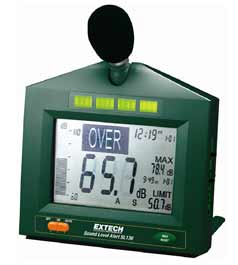 As employers at night clubs, discotheques, and pubs look for ways to ensure compliance with the new laws and effective ways to alert employees to dangerous noise levels, the use of a Type 2-compliant sound level meter can be instrumental in continuously monitoring ambient noise levels in workplaces. One model, the Extech SL130, also provides visual alerts (flashing jumbo LEDs) to employees when sound levels exceed the maximum noise level as defined by new EU-wide noise-at-work regulations. When noise exceeds the limit, large green or red LEDs flash brightly and can be seen as far as 30m away alerting employees to wear hearing protection.
For an additional alert located in another part of the work place, the SL130's auxiliary alarm output, when connected to a remote alarm relay, can be used to power external warning signs, “QUIET” signs or other indicating devices when the sound level is higher than the programmed limit.
Monitoring Employees' Daily Personal Exposure Levels
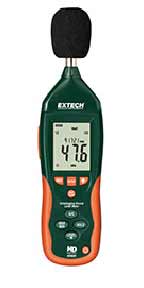 Additionally, an important part of the regulations are based on an employee's daily personal exposure level. This is a worker's one-day exposure to noise in the workplace (normalized to an 8-hr. day) and it takes into account the average levels of noise one is exposed to in the course of the day, in different locations in the workplace. To track this, a high quality Type 2 sound level meter capable of recording sound level samples over the course of a work day is used to determine the daily average exposure.
For example, the Extech HD600 permits employers to record or "datalog" up to 20,000 sample points of noise levels, each with a date- and time-stamp. This data can be downloaded to a computer via USB cable and analyzed using included software to calculate daily personal exposure levels. Ideally, the meter used should meet Type 2 IEC 61672-1 standards and can be tripod-mounted or fixed for optimal placement in a workplace.
Looking Ahead
As we look at noise management solutions and the emerging legal landscape that mandates them, the perspective of how one industry is grappling with a new set of stricter regulations can help inform how your company anticipates and tackles compliance with similar new laws. Monitoring and data record-keeping plays a key role in effective compliance, protecting your employees and minimizing your legal liability.


 As employers at night clubs, discotheques, and pubs look for ways to ensure compliance with the new laws and effective ways to alert employees to dangerous noise levels, the use of a Type 2-compliant sound level meter can be instrumental in continuously monitoring ambient noise levels in workplaces. One model, the Extech SL130, also provides visual alerts (flashing jumbo LEDs) to employees when sound levels exceed the maximum noise level as defined by new EU-wide noise-at-work regulations. When noise exceeds the limit, large green or red LEDs flash brightly and can be seen as far as 30m away alerting employees to wear hearing protection.
 Additionally, an important part of the regulations are based on an employee's daily personal exposure level. This is a worker's one-day exposure to noise in the workplace (normalized to an 8-hr. day) and it takes into account the average levels of noise one is exposed to in the course of the day, in different locations in the workplace. To track this, a high quality Type 2 sound level meter capable of recording sound level samples over the course of a work day is used to determine the daily average exposure.