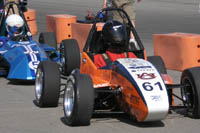
 How much fun can a college student have with a thermocouple electrode? Just ask David Smith, the braking systems engineer on the Auburn University Formula SAE® student race team. As part of a sponsorship deal with the Alabama college, provided Smith and his teammates with a pair of Type J PTFE moving surface probes to use in the development of their open-cockpit race car. We guarantee he’s having a lot more fun with them than we ever could.
Since 1981, the Society of Automotive engineers (SAE) has sponsored a Formula SAE competition allowing students to conceive, design, fabricate, and compete with small, formula-style racing cars. More than 140 major engineering colleges and universities worldwide participate in the program, developing prototype cars and building a new one from scratch each year as a student team effort. They compete for best in safety, cost, design, presentation, acceleration, skidpad, autocross, and endurance, and are judged by the race engineering elite with support from top engineers at Ford, GM, and DaimlerChrysler.
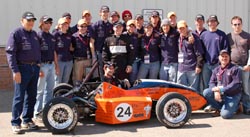 The Auburn team is one of the best, having placed 15th out of 140 in 2006, 5th overall in 2003, and 3rd overall in 2004.
So, what are they doing with our Type J probes? The team is using them to monitor brake rotor temperature. It turns out that during the 2006/07 season, Auburn is one of three teams working with Michelin to develop a competition tire for the entire Formula SAE field. The students also have a fanatical focus on overall weight reduction and in the development of a more versatile suspension system—which translates into increased stress loads on the wheel assemblies and brake rotors. And they don’t want the rotors to overheat.

We recently ran tests on two prototype tire compounds at Michelin’s Laurens Proving Grounds in South Carolina, Smith says. Their track is similar to the one we will race on in competition and the data looked good.
Smith’s team needed accurate temperature readings in order to design next year’s rotors, which need to be as light, yet as strong, as possible. A poorly designed front rotor shattered during testing last year.
The team had previously written programs to estimate rotor temperature, and needed real data to confirm their findings. To do so they focused infrared thermocouples on each of three tires to get accurate tire temperatures, then coupled that data with the data from wheel speed sensors and a throttle position sensor. Smith then fabricated sheet metal mounting brackets for the Type J PTFE temperature probes, and mounted them to the caliper and wheel uprights. The combined data this provided confirmed the estimates drawn up by the students (see Graph A).
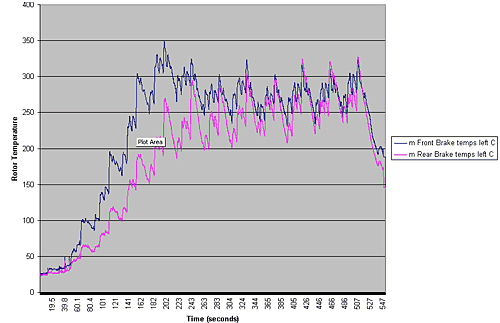
With this confirmation, we can design next year's rotors to be as light as possible without sacrificing durability, says Smith.
And with new rotors, who knows how high the team might score in 2007!


 How much fun can a college student have with a thermocouple electrode? Just ask David Smith, the braking systems engineer on the Auburn University Formula SAE® student race team. As part of a sponsorship deal with the Alabama college, provided Smith and his teammates with a pair of Type J PTFE moving surface probes to use in the development of their open-cockpit race car. We guarantee he’s having a lot more fun with them than we ever could.
 The Auburn team is one of the best, having placed 15th out of 140 in 2006, 5th overall in 2003, and 3rd overall in 2004.
