 OSHA's new requirements for reporting severe workplace injuries and fatalities went into effect January 1, 2015. These requirements are in response to the Bureau of Labor statistics revealing 4,405 workers were killed on the job in 2013.
As U.S. Secretary of Labor Thomas E. Perez emphasized in a Department of Labor release, “Workplace injuries and fatalities are absolutely preventable, and these new requirements will help OSHA focus its resources and hold employers accountable for preventing them."
Preventing injuries before they occur not only protects workers but also limits expenses from workers’ compensation and loss of productivity. While some hazards are not containable, many are.
“You can’t control a tornado hitting your manufacturing plant,” wrote Ray Gage in EHS Today, “but you can control employees’ compliance with corporate rules regarding the wearing of personal protective equipment; that employees are not lifting boxes beyond their physical capabilities; and that they are not walking on floors slipperier than an ice skating rink.”1
Personal protective equipment, or PPE, is designed to safeguard workers from many of the risks they encounter on a daily basis: cuts, abrasions, flying objects, radiation, excessive noise, electrical sparks, chemical splashes, and more.
PPE to the Rescue
While it can’t eliminate all safety threats, the proper use of PPE can significantly decrease the likelihood for many injuries. Manufacturing plants may be rife with loud noise and moving objects. Labs offer potential for chemical splashes or biohazards. Construction sites may invite falling objects or harmful dust. Each work setting embodies its own mix of risks that only a hazard assessment may reveal. PPE helps mitigate these hazards including:
- Eye and face protection: Flying objects, chemicals, dust, and vapors are among the many perils that create the need for safety glasses, goggles, and face shields. Regular prescription glasses are typically not enough for adequate protection.
- Head protection: Many serious head injuries result from explosions, falls, and other traumatic events. OSHA states that hard hats can protect workers “from impact and penetration hazards as well as from electrical shock and burn hazards.” 2 For full support, ensure hard hats fit effectively and offer shock-absorbing features.
- Hand (and arm) protection: When cuts from sharp objects are possible or harmful substances can penetrate the skin, hand and arm coverage is needed. Burns, cuts, abrasions, and other afflictions can be avoided with the correct type of safety gloves. Options range from temperature-resistant gloves to arc flash gloves to finger cots.
- Respiratory protection: Airborne particles, gas, and chemicals can infiltrate and irritate the lungs. To select the adequate level of protection, determine the level of particulate removal or filtration efficiency needed. Gas mask respirators, respirator hoods, full-face respirators, half-mask respirators, and safety face masks are among the choices for protection.
- Hearing protection: To preserve hearing in environments containing excessive noise, employees must wear hearing protectors. Typically, earplugs or earmuffs, which seal the area around the ear, are used. When selecting hearing protectors, look for noise reduction rating (NRR) and compliance level.
- Foot protection: Working with heavy or sharp objects, electrical hazards, or extreme temperatures requires safety footwear to prevent impact. Many types of safety footwear are on the market, including special-purpose shoes to address specific electrical or temperature dangers.
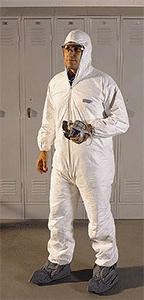
- Body protection: Exposed areas of the body are vulnerable to hot splashes or external impact. From laboratory coats to coveralls to aprons, protective clothing is available in various materials. Look for fire resistance and special fabrics to safeguard the body from chemical and physical threats.
Taking Compliance Seriously
Hazard assessments determine which PPE is needed to address each potential danger in a work setting. Yet simply having PPE is not enough. Each item must be fitted properly, worn regularly, and inspected for signs of wear or the need for replacement.
Training programs to educate workers on the appropriate use and care of PPE are a necessity. OSHA also recommends habitually evaluating and updating training to maximize efficacy.
While eliminating hazards may be the best strategy, it may not always be possible. Jets taking off at airports produce high noise levels. Research & development labs use hazardous chemicals to create useful products. Electrical maintenance workers test voltage and electrical performance to keep systems working. When processes themselves cannot remove the hazard, minimizing exposure to injury—and continually enhancing safety practices—protects workers.
View our entire selection of Safety Apparel.
1 Gage, Ray. “Take The Steps To Prevent Workplace Injuries Before They Happen,” EHS Today. Retrieved from http://ehstoday.com/safety/take-steps-prevent-workplace-injuries-they-happen on December 3, 2014.
2 OSHA. “Personal Protective Equipment.” Retreived from https://www.osha.gov/Publications/osha3151.pdf on December 3, 2014.


