

The Essential Guide to Variable Area and Laminar Differential Pressure Flowmeters: What You Need to Know
Accurately measuring the flowrate of fluids and gases is essential across various industries, from bioprocessing workflows to industrial gas monitoring. Understanding the difference between mass and volumetric flow, as well as the advantages of different flowmeter types, helps ensure precise measurements for efficiency and safety. In this article, we’ll explore mass vs. volumetric flow, variable area and laminar differential pressure (DP) flowmeters, and essential flow conversion factors to simplify your calculations.
In this article you’ll learn:
- Mass Flow vs. Volumetric Flow: Understanding the Difference
- Variable Area Flowmeters: Direct Read and Correlated
- Laminar Differential Pressure (DP) Flowmeters
- Flow Conversion Factors & Standard vs. Actual Flow Measurements
Mass Flow vs. Volumetric Flow: Understanding the Difference
Flow measurement is a critical factor in many industrial and scientific applications, but not all flow measurements are the same. The distinction between mass flow and volumetric flow is essential when selecting the right flowmeter for a given process. While volumetric flow measures the physical volume of fluid moving through a system, mass flow accounts for the actual mass of the fluid, which remains constant regardless of temperature and pressure changes.
- What is Volumetric Flow?
Volumetric flow measures the volume of a gas or liquid that flows through a system in a certain amount of time, expressed in units like liters per minute (L/min or LPM), cubic meters per second (m³/s), or milliliters per minute (mL/min). This type of measurement is highly dependent on external conditions: gases, for example, expand or contract with changes in pressure and temperature, altering the measured volume without changing the actual quantity of gas present.
- What is Mass Flow?
Mass flow measures the actual quantity of fluid, liquid or gas, moving through a system in a certain amount of time, expressed in kilograms per second (kg/s), pounds per hour (lb/hr), or standard liters per minute (SLPM) for gases. Unlike volumetric flow, mass flow remains constant even when pressure and temperature fluctuate, making it ideal for applications where precise amounts of material need to be delivered.
|
Flow Type |
Best For | Example Applications |
| Volumetric Flow | Liquids or gases when temperature and pressure are stable |
Water distribution, HVAC airflows, food and beverage production |
| Mass Flow | Precise gas flow measurement, varying temperature/pressure conditions | Clinical research gas delivery, semiconductor manufacturing, chemical processing |
Understanding whether your application requires volumetric or mass flow is essential to choosing the right type of flowmeter and ensuring accurate, reliable measurements.
Variable Area Flowmeters
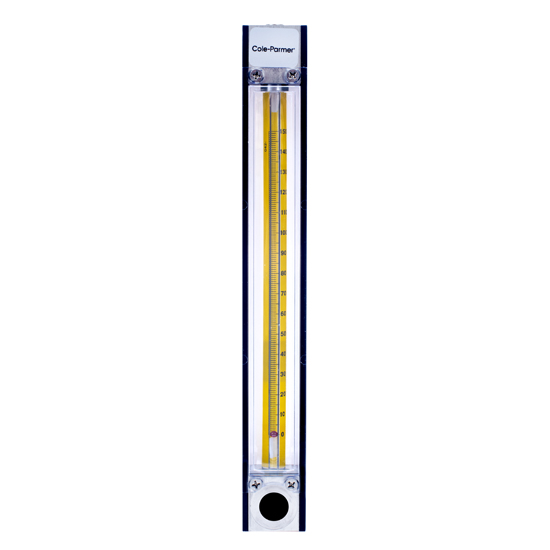
Cole-Parmer variable area flow meter
A variable area flowmeter, commonly known as a rotameter, is a simple and reliable device used to measure gas or fluid flow rates. It consists of a tapered tube with a float inside that moves up and down based on the flow rate. As the media flows upward, the float rises until the forces acting upon it (velocity, gravity, and buoyancy) reach equilibrium. The height of the float corresponds to the flow rate, which can be read on a scale.
Variable area flowmeters are widely used because they are mechanically simple, cost-effective, and require no external power. They are particularly well suited for low-flow liquid and gas applications where real-time monitoring is needed.
Variable area flowmeters come in two primary types: direct read and correlated flowmeters.
- Direct Read Flowmeters
- Have a scale that is pre-calibrated for a specific media (e.g., air or water) at a given temperature and pressure.
- Allow users to read the flow rate directly from the scale, eliminating the need for conversions, charts, or additional calculations.
- Simple to use but limited in flexibility, as they must be recalibrated or replaced if used with different media or conditions.
- Correlated Flowmeters
- Do not have a direct flow scale; instead, they provide a dimensionless scale (e.g., 0 to 100) that requires a separate correlation chart or equation to determine the actual flow rate.
- Can be used with multiple fluids or gases by applying conversion factors based on specific operating conditions.
- Offer greater versatility but require additional calculations for precise readings.
Variable area flowmeters are used in various industries due to their simplicity and versatility. Some common applications include:
- Water treatment plants – Monitoring chemical dosing and water flow rates.
- Laboratories and research – Low-flow gas or liquid measurements in experimental setups.
- HVAC systems – Monitoring airflow in ventilation systems.
- Industrial gas flow measurement – Ensuring controlled delivery of gases in welding and manufacturing.
Variable area flowmeters are an excellent choice for applications where simplicity, affordability, and visual flow monitoring are priorities. While they may not offer the precision of digital or mass flowmeters, they remain a reliable and widely used option in many industries.
|
Advantages |
Disadvantages |
|
|
Laminar Differential Pressure (DP) Flowmeters
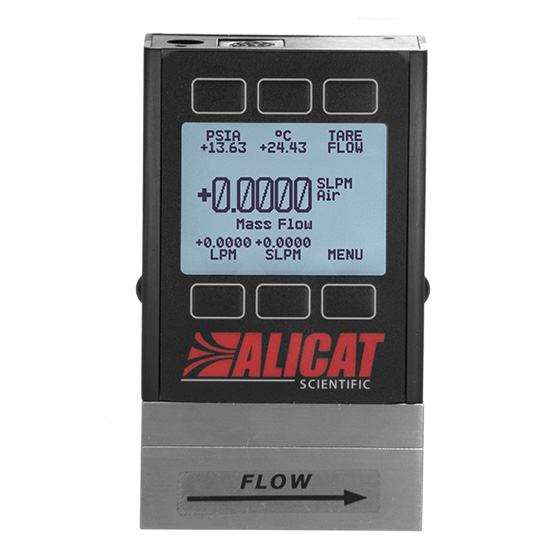
Alicat Scientific laminar differential pressure mass flow meter with a digital display
Laminar differential pressure (DP) flowmeters are precision instruments used to measure flow rates of both liquids and gases by utilizing the principles of laminar flow. Unlike conventional DP flowmeters that rely on turbulent flow conditions, these flowmeters use a laminar flow element (LFE) to create a controlled pressure drop, which directly correlates to the flow rate. This ensures high accuracy, repeatability, and stability, making them ideal for low-flow applications where precision is critical.
Laminar DP flowmeters operate based on Poiseuille’s Law, which states that in laminar flow conditions, pressure drop is directly proportional to volumetric flow rate. These flowmeters contain a laminar flow element (LFE)—a set of parallel, small-diameter flow channels that ensure the fluid moves in a predictable, non-turbulent manner.
Key Components:
- Laminar Flow Element (LFE): Creates a uniform, non-turbulent flow to ensure accurate pressure drop readings.
- Differential Pressure Sensor: Measures the pressure drop across the LFE and converts it into a flow rate.
- Electronics & Signal Processing: Modern versions include digital compensation for temperature and pressure variations to enhance accuracy.
While laminar DP flowmeters can measure both liquids and gases, their design and function differ slightly depending on the medium.
- Gas Flow Measurement:
- Commonly used in applications requiring precise low-flow gas measurements, such as research gas monitoring and industrial gas flow control.
- Requires correction for temperature and pressure changes to maintain accuracy.
- Often used with standardized flow conditions (e.g., SLPM instead of LPM) to ensure consistent readings.
- Liquid Flow Measurement:
- Used in high-precision liquid dosing, fuel flow monitoring, and chemical processing.
- Less affected by pressure and temperature variations than gas flow but may require viscosity compensation for different liquids.
- Offers excellent repeatability, making it suitable for pharmaceutical and laboratory applications.
|
Advantages |
Disadvantages |
|
|
Flow Conversion Factors & Standard vs. Actual Flow Measurements
This table provides quick reference for converting between common flow rate units used in different industries, also you can use our flow-meter conversion tool.
| Measurement | Convert To | Multiply By |
| Gallons per minute (GPM) | Cubic meters per second (m³/s) | 0.00006309 |
| Gallons per minute (GPM) | Liters per minute (L/min or LPM) | 3.785 |
| Liters per minute (L/min or LPM) | Cubic meters per hour (m³/h) | 0.06 |
| Liters per minute (L/min or LPM) | Cubic centimeters per minute (cc/min or CCM) | 1,000 |
| Milliliters per minute (mL/min) | Liters per minute (L/min or LPM) | 0.001 |
| Cubic centimeters per minute (cc/min or CCM) | Liters per minute (L/min or LPM) | 0.001 |
| Cubic feet per minute (CFM) | Cubic meters per hour (m³/h) | 1.699 |
| Cubic feet per minute (CFM) | Liters per minute (L/min or LPM) | 28.3168 |
| Cubic feet per minute (CFM) | Cubic centimeters per minute (cc/min or CCM) | 28,316.80 |
| Pounds per hour (lb/hr) | Kilograms per hour (kg/hr) | 0.453592 |
| Cubic meters per hour (m³/h) | Liters per minute (L/min or LPM) | 16.667 |
- Understanding Standard vs. Actual Flow Measurements
- When measuring gas flow, it’s important to distinguish between actual and standardized flow rates.
- Actual Flow Rate (LPM, CFM, etc.): Measured under the actual temperature and pressure conditions in a system. This can fluctuate based on environmental changes.
- Standard Flow Rate (SLPM, SCFM, etc.): Corrected to a standard reference temperature and pressure, ensuring consistency across measurements and industries.
- Common Standard Conditions:
- Standard temperature: 0°C (32°F) or 20°C (68°F), depending on the industry.
- Standard pressure: 1 atmosphere (101.325 kPa or 14.7 psi).
- Since gas expands and contracts with temperature and pressure changes, standard flow rates allow for accurate comparisons between different operating conditions.
- When measuring gas flow, it’s important to distinguish between actual and standardized flow rates.
Find the Perfect Flowmeter with Cole-Parmer
Choosing the right flowmeter is essential for accurate and reliable fluid measurement, and Cole-Parmer offers a wide selection of high-quality flowmeters to meet your needs. Whether you’re looking for variable area flowmeters, laminar differential pressure flowmeters, or other precision instruments, we provide top brands like Cole-Parmer and Alicat, known for their accuracy and durability. Our team of experts is here to help you select the best flowmeter for your specific application, ensuring optimal performance and efficiency. Shop our entire collection of Flowmeters today.
References
Alicat What is the difference between mass flow and volumetric flow?